Orangeburg Criminal Court Records
Criminal court records in Orangeburg County begin when a criminal case is opened in court. General Sessions, the criminal side of Circuit Court, handles more serious criminal cases. Magistrate Court and Municipal Court handle summary offenses, traffic-related criminal matters, preliminary hearings, bond matters, and qualifying misdemeanors within their jurisdiction. The Orangeburg County Clerk of Court is the primary records custodian for Circuit and Family Court records, while summary court records are tied to the relevant Magistrate or Municipal Court.
A criminal court record is broader than the initial charge. It can show the charging document, arraignment, bond entries, hearing dates, motions, plea negotiations, trial activity, verdict, disposition, sentence, probation orders, and later expungement or sealing activity. For the charge list itself and the arrest-to-charge pathway, the separate court charge record page is the better fit. For broad civil, family, probate, traffic, and court records across Orangeburg County, the general court records page is the starting point.
The First Circuit Solicitor is the prosecuting office for General Sessions criminal cases in Orangeburg County. The Solicitor's role matters because prosecutors decide how filed criminal charges proceed in court.

Search Orangeburg Criminal Case Records
The main online search channel for Orangeburg County criminal court records is the South Carolina Judicial Branch Case Records Search, which links to the direct Orangeburg Public Index. The statewide page says users need cookies and JavaScript, and case detail may require a pop-up exception. If the online record does not show enough detail, the Clerk of Court at 151 Docket Street is the local fallback for Circuit Court criminal records.
- Start with the Judicial Branch case-search page and select Orangeburg County.
- Use the Public Index to search by defendant name, case number, or other available case details.
- Open the case record and review the docket entries, charges, hearings, pleas, and disposition.
- Check the court level before relying on the result because Magistrate, Municipal, and General Sessions records differ.
- Request Clerk verification or certified copies when the record will be used for court, licensing, or official proof.
State criminal-history systems are not the same as the court file. A criminal history may summarize arrests, charges, or dispositions, while the court file shows what happened in the Orangeburg County case. If a person is in custody, jail and inmate channels are separate from the case record.
Orangeburg County Criminal Courts
South Carolina uses Solicitors as prosecutors. Orangeburg County is part of the First Judicial Circuit, and the First Circuit Solicitor prosecutes General Sessions cases. Magistrate Court handles arrest warrants, search warrants, bail, preliminary hearings, and summary criminal matters. Municipal Court handles city and town offenses inside municipal limits. City of Orangeburg Municipal Court handles Department of Public Safety traffic tickets and misdemeanor arrests inside the city.
| Court or Office | Criminal Record Role | Orangeburg County Channel |
|---|---|---|
| Circuit Court, General Sessions | Serious criminal cases, indictments, pleas, trials, dispositions, and sentences. | Public Index and Clerk of Court. |
| First Circuit Solicitor | Prosecution of General Sessions criminal cases and many expungement applications. | First Circuit Solicitor site and staff. |
| Magistrate Court | Summary criminal cases, warrants, bail, preliminary hearings, and county traffic crimes. | Central, Eastern, Western, Bond, and Preliminary Court contacts. |
| Municipal Court | Municipal ordinances and qualifying misdemeanors inside town or city limits. | Relevant municipal court, including Orangeburg Municipal Court. |
| Public Defender | Court-appointed defense for financially eligible defendants. | Orangeburg public defender page through SCCID. |
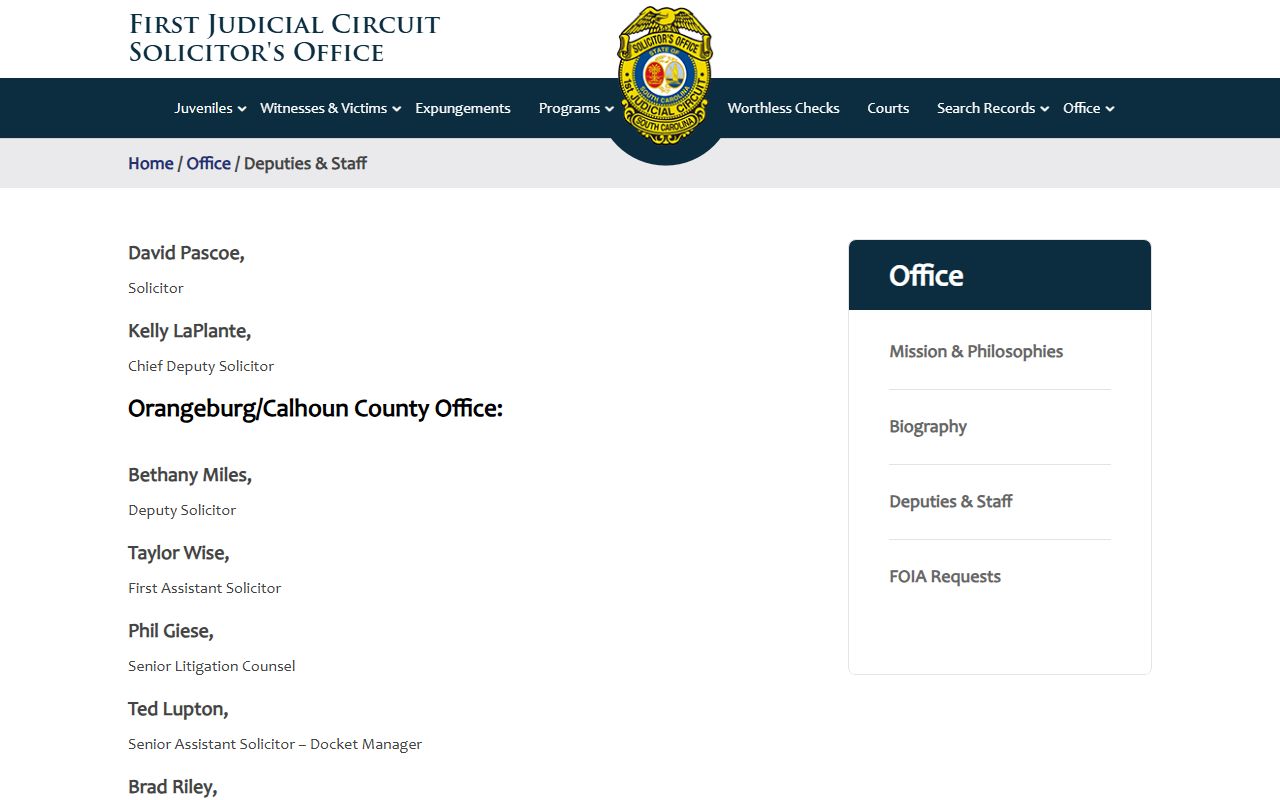
The First Circuit Solicitor deputies and staff page lists Orangeburg and Calhoun office personnel, including Deputy Solicitor, assistant solicitor, and docket manager roles.
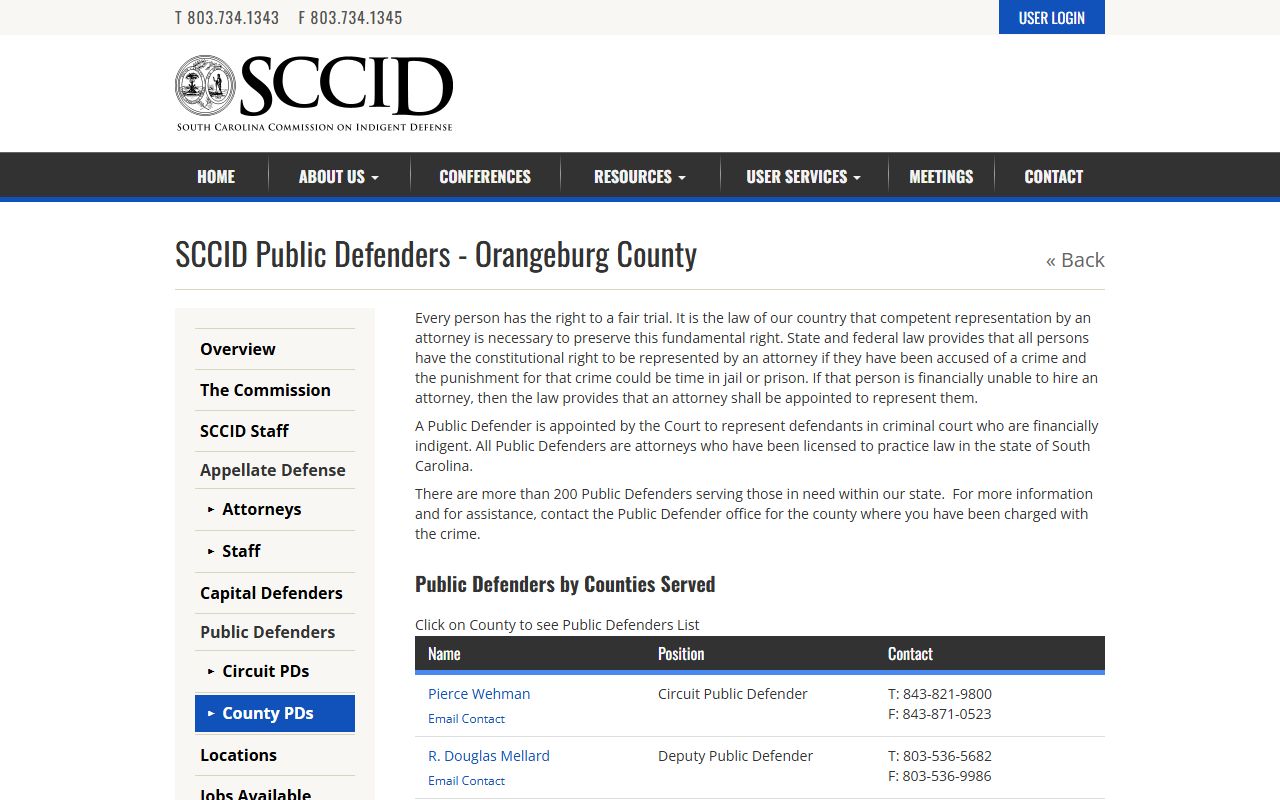
The Orangeburg public defender page explains the defense side of criminal court for people found financially indigent by the court.
Orangeburg Criminal Case Flow
A criminal case record changes as the case moves. An arrest or warrant may lead to charges. The case then appears in the appropriate court. Bond and first appearance events can occur early, especially when a person is jailed on a warrant. The record may later show arraignment, motion practice, plea negotiations, trial, disposition, and sentencing. Not every case reaches every stage.
Case flow: Charges Filed › Arraignment › Pretrial and Motions › Plea or Trial › Disposition › Sentencing
| Stage | What the Criminal Court Record May Show |
|---|---|
| Charges Filed | Offense description, statute or citation, warrant or citation number, and court assignment. |
| Arraignment | The defendant is advised of charges and enters a plea or receives plea-related scheduling. |
| Pretrial and Motions | Continuances, discovery issues, bond matters, suppression motions, and other court requests. |
| Plea or Trial | A plea, verdict, trial setting, bench action, or jury result may be entered. |
| Disposition | The charge outcome, such as guilty, not guilty, dismissed, nolle prosequi, or other final status. |
| Sentencing | Jail, prison, probation, fine, restitution, suspended sentence, or other court-ordered result. |
What Criminal Court Records Show
Orangeburg County criminal court records can contain both event history and outcome data. The Public Index can help locate the case, but it is not always the certified record of court action. Some older or non-digitized records may require in-person or mail contact with the Clerk. Some information may be removed from public display because of redaction rules, expungement, sealing, juvenile confidentiality, or protected personal information.
| Field | What It Shows |
|---|---|
| Case Number | The case identifier used by the court, although the exact Orangeburg portal format was not verified in text. |
| Defendant | The person accused in the criminal case, subject to display and privacy rules. |
| Charges | Offense description, statute or citation, charge level, warrant or citation reference, and status. |
| Bond | Bond amount, conditions, or bond-related hearing entries when available. |
| Plea | The defendant's answer to a charge, such as guilty or not guilty. |
| Disposition | The charge or case outcome, including conviction, dismissal, acquittal, or nolle prosequi. |
| Sentence | The punishment or conditions ordered after conviction or plea. |
Charges and Convictions
Being charged is not the same as being convicted. Orangeburg County criminal court records may show charges that were reduced, amended, dismissed, or ended in acquittal. A conviction exists only after a guilty plea, guilty verdict, or other court finding that produces a conviction. Disposition must be read charge by charge because one case can have several counts with different outcomes.
| Point | Charge | Conviction |
|---|---|---|
| Meaning | An accusation filed or pursued in court. | A final finding or admission of guilt. |
| Record Stage | Appears early and may change. | Appears after plea, verdict, or final adjudication. |
| Outcome | May be pending, amended, reduced, dismissed, or nolle prossed. | May lead to sentence, probation, fines, or collateral effects. |
| How to Read It | Check current charge status. | Check disposition and sentence fields. |
Sealed and Expunged Records
South Carolina expungement applications are administered through the solicitor's office for the circuit where the charge or conviction is located. For Orangeburg County, that points to the First Judicial Circuit for many General Sessions criminal-record expungements. Non-convictions, dismissed or nolle prossed charges, certain first-offense summary convictions, conditional discharges, and youthful-offender categories may qualify depending on facts and waiting period. Major offenses generally cannot be expunged.
| Point | Sealed Record | Expunged Record |
|---|---|---|
| Public View | Closed from ordinary public access by law or court order. | Removed from ordinary public criminal-record access after a qualifying order. |
| How It Happens | By rule, statute, or court order. | Through a statutory expungement process handled through the proper office. |
| Online Effect | May not appear in the Public Index or may show limited information. | May disappear from public criminal history and court access channels. |
| Orangeburg Fallback | Ask the court that sealed it. | Start with the First Circuit Solicitor or the appropriate summary court. |
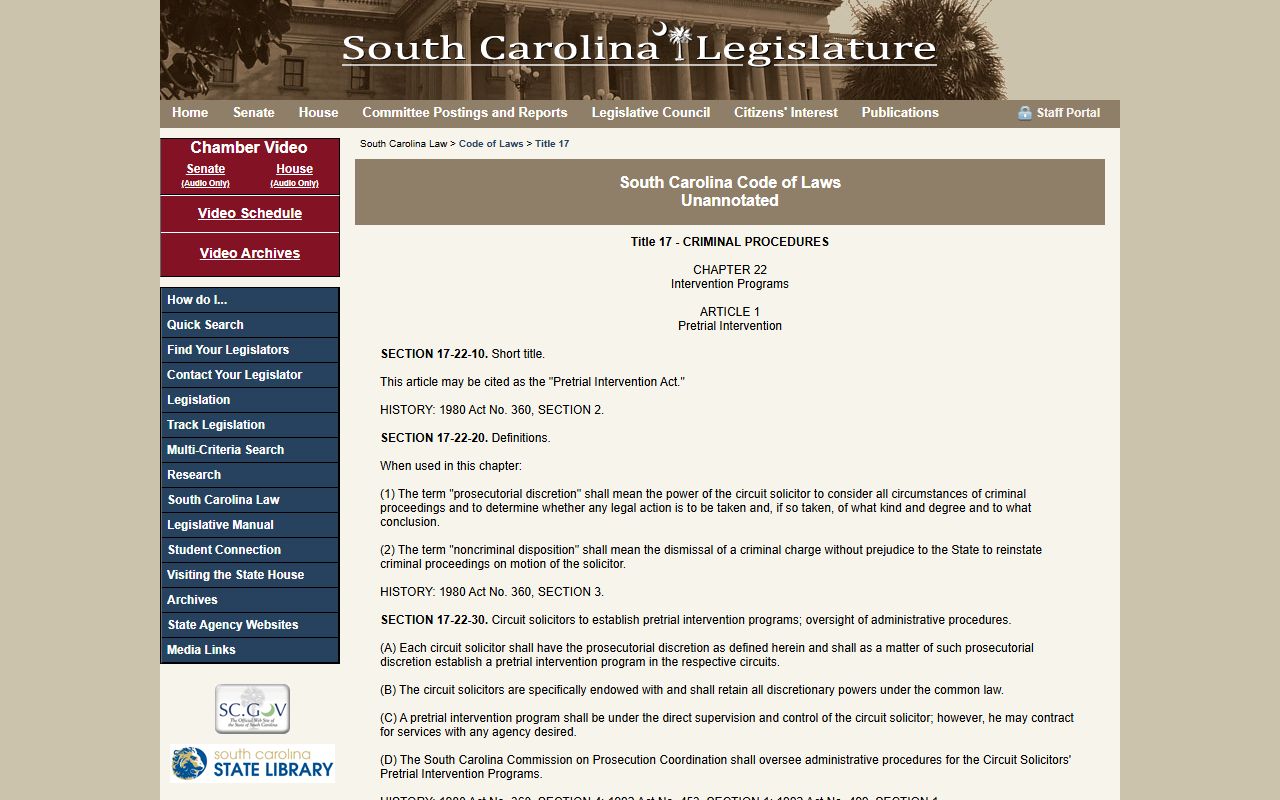
The South Carolina expungement statutes are central to Orangeburg County criminal court records because an expungement can remove eligible records from ordinary public access.
Restricted Orangeburg Criminal Records
Juvenile court records are confidential under S.C. Code Section 63-19-2010 and should not be treated like adult criminal court records. Adoption-related Family Court files are also restricted. Records can also be redacted under court rules that protect Social Security numbers, financial account numbers, minor names, personal identifying information, and home addresses. The statewide Public Index no longer displays home address information for new or existing cases as of January 1, 2026.
Open criminal court records still need careful reading. A docket entry is not a conviction. A charge may have been dropped. A defendant may have several charges with different outcomes. If official use is planned, contact the Clerk of Court for certified copies, then verify any pending bond, sentence, or probation condition with the court that entered it.
Note: Juvenile, sealed, expunged, and redacted criminal records may not appear in ordinary Orangeburg County public searches.
The South Carolina juvenile records provisions explain why juvenile criminal-style matters are not ordinary public Orangeburg County criminal court records.